
Tips
Why Your Shop Is Losing Customers at the Counter

Meiket Team · November 16, 2026
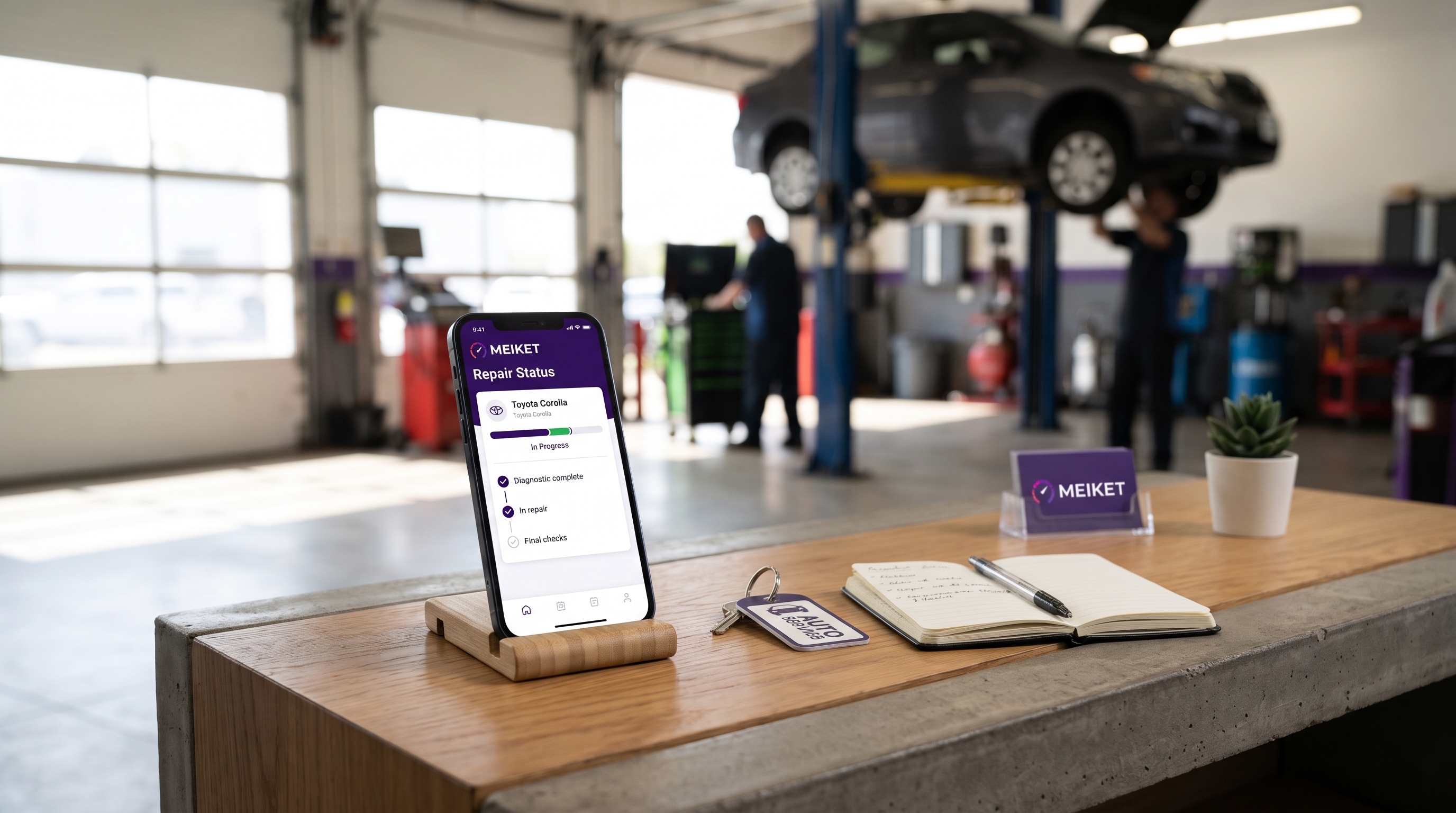
A customer drops off their car, you quote the job, and somewhere between that conversation and the car leaving the lot, the thread gets lost. A sticky note goes missing. A text never gets sent. The customer calls to ask what’s going on, gets put on hold, and the next time their car needs work, they try a different shop. None of that shows up as a single bad review — it just shows up as a slow leak in repeat business.
The counter is where shops actually lose customers
Most shop owners assume they lose customers over price or quality of work. More often, it’s the handoff — the moment a job’s status has to move from someone’s head, or a scrap of paper, into the customer’s hands. That handoff point is the counter, and it’s where a surprising amount of a shop’s communication breaks down: who approved what, who still needs a callback, which car is actually ready.
A customer doesn’t walk because the brake job was wrong. They walk because they called three times to find out if it was done.
This matters more than it looks like it should, because a repair shop’s whole business is built on repeat visits and referrals. A customer who’s happy with the work but annoyed by the process doesn’t leave a bad review — they just quietly start calling someone else the next time a check-engine light comes on. You never see that loss in your numbers as “lost a customer because of the counter.” You see it as a slightly quieter month, with no obvious cause.
What a lost customer at the counter actually costs
The direct cost is obvious — one customer, one ticket, gone. The less obvious cost is what it does to your front-of-house time. Every status-check call is a few minutes your advisor isn’t spending on the next estimate or the next approval. Multiply that across a full day of work orders, and the counter stops being a quick handoff and starts being the bottleneck for the whole shop.
It also compounds in a way that’s easy to miss. A customer who had to chase you for an update doesn’t just not come back — they tell the next person who asks for a shop recommendation. In a local market, word of mouth runs both directions: a smooth experience gets repeated, and so does a frustrating one. The shop down the street isn’t necessarily cheaper or faster at the actual repair. It just didn’t make the customer call three times.
There’s a staffing cost too, even if it’s invisible on a schedule. An advisor who’s constantly interrupted by “any update on my car?” calls isn’t just annoyed — they’re context-switching all day, which means estimates take longer to write and approvals take longer to chase down. The counter becomes the slowest part of the shop, not because anyone there is slow, but because they’re doing two jobs at once: moving the next car through, and re-explaining the status of cars that already have one.
Where the breakdown actually happens
The failure point is rarely one dramatic mistake. It’s a handful of small, ordinary habits that add up:
- Paper notes and sticky notes move with the car, not with the information. If the tech is heads-down in the bay, nobody’s updating the slip of paper at the front, and the person at the counter is working from whatever was true an hour ago.
- Phone tag — the customer calls when you’re mid-estimate on another vehicle, you call back when they’re in a meeting, and the update sits unsent for hours while both sides assume the other one will follow up.
- No single source of truth. If the only record of a job’s status lives in one advisor’s memory, it disappears the moment they step away from the counter, go to lunch, or have a day off.
- Approvals that require a callback. Every estimate that has to wait for a phone call back is a job sitting idle in a bay while you play phone tag, and every hour it sits idle is an hour that bay isn’t making money on the next car.
- Shift handoffs with no record. The morning advisor knows where three jobs stand. The afternoon advisor doesn’t, because nothing was written down anywhere both of them can see.
Important: none of this is about hiring more front-counter staff. It’s about whether a job’s status exists somewhere a customer can check without calling — and somewhere your team can see without asking around.
Signs your counter is already the bottleneck
A few questions tend to surface the problem faster than trying to measure it directly:
- Can anyone at the counter say, right now, exactly how many jobs are waiting on approval versus already in the bay — without walking back to check?
- How many times today did someone call in just to ask “is it ready yet”?
- If your lead advisor called in sick tomorrow, would the rest of the team know the status of everything currently open?
- Do sticky notes or a paper log still exist anywhere near the register at closing time?
If the honest answer to any of these is “not really” or “yes,” the counter isn’t a minor inconvenience — it’s the actual constraint on how many jobs your shop can run through cleanly in a day, independent of how many bays you have or how fast your techs are.
What a tighter counter workflow looks like
The fix isn’t more phone calls, it’s fewer of them. A shop with a tight counter workflow has one place where every work order’s status lives — estimate sent, approval pending, in the bay, ready for pickup — visible to whoever’s at the counter without them having to ask the tech, and visible to the customer without them having to call.
That’s the operating system logic behind how Meiket handles the counter: one panel for every open order, a status the customer can check from their phone instead of a callback, and a protocol — estimate, approval, bay, close — that doesn’t depend on a sticky note surviving the day.
Making the fix stick, not just installing it
Whatever system a shop uses, the habits around it matter as much as the tool itself. A few things that make a single-source-of-truth approach actually stick day to day:
- Pick one place and mean it. If status still lives half in the new system and half in someone’s head “just for now,” the old failure mode survives. The rule has to be: if it’s not in the shared place, it’s not official.
- Set the expectation with the customer up front. Tell them how they’ll hear about updates — a text, a link, a call only if something changes — so they’re not calling to check in the first place.
- Review open jobs at shift change, not just at the end of the day. A thirty-second look at what’s open closes the gap between the morning advisor and the afternoon one.
- Treat a repeated status-check call as a signal, not an interruption. If a customer is calling more than once, something about how they were told to expect updates didn’t land — that’s worth fixing at the source, not just answering politely each time.
None of this requires more headcount. It requires making the status of a job visible in one place, consistently, instead of relying on memory and goodwill to keep it accurate.
FAQ
Why do customers leave my shop even when the repair was good?
Most of the time it’s not the repair — it’s not knowing where things stood while they waited. A customer who had to call multiple times for a status update remembers the friction, not the quality of the brake job.
How do I stop losing track of jobs at the counter?
Move the job’s status out of someone’s head or a loose note and into a single place everyone at the counter — and the customer — can check. The fewer status updates that depend on a phone call, the fewer jobs get lost in the handoff.
Is this just a bigger staff problem?
No — adding front-counter staff doesn’t fix a missing source of truth, it just adds more people who have to ask around for the same information.
How many status-check calls is "too many" for a shop my size?
There’s no universal number, but if advisors can’t remember a day without at least a few “just checking” calls, that’s a sign the handoff point — not the repair work — is where customers are losing confidence.
Do I need new software to fix this, or can I just change how we work?
Habits alone can get you partway there — a shared whiteboard or shared note is better than nothing. But habits tend to slip under pressure on a busy day, which is exactly when the counter breaks down the most. A system that makes the status visible without relying on someone remembering to update it holds up better over time.